

Study Finds Small-Scale Irrigation Can Transform Himalayan Farm Incomes — But Sustainability Hinges on Protecting Water Sources
A new independent study has found that small, well-targeted irrigation interventions — a spring diversion, a solar-powered lift pump, a lined storage tank — can lift per-household farm incomes in Uttarakhand’s mid-Himalayan villages by five to ten times, and in the best cases by nearly twenty-fold, compared with rainfed farming alone. But the same study warns that many of these schemes are being built without protecting the water sources that feed them, putting their long-term survival at risk.
Titled Sustainability of Water Interventions for Livelihoods in the Himalayas, the study was carried out by P-Green Solutions, Dehradun, on behalf of CEDAR, Dehradun, with funding from the IWMI-TATA Water Policy Research Program, Anand. The assignment ran from September 2025 to February 2026 and was led by Dr. Y. P. S. Bisht as Principal Investigator, with field research conducted across twelve villages in six mountain districts of Uttarakhand: Pauri Garhwal, Dehradun, Tehri Garhwal, Uttarkashi, Nainital and Almora.
Water availability, not land, is the binding constraint on farm livelihoods across the region — more than four-fifths of cultivated land in Uttarakhand’s hill districts is rainfed, and farmers across the study villages consistently reported shorter, more erratic monsoons and drier winters than a decade ago. The study set out to examine not whether small irrigation schemes work, but whether they last, and what would make them last longer.
Where Irrigation Reaches, Incomes Follow
Where water became available, farmers shifted decisively toward vegetables, spices and cash crops. Crop productivity in irrigated villages rose by roughly 2 to 2.5 times, and per-household farm income rose by 5 to 10 times compared with pre-intervention levels. The gap was starkest between the study’s rainfed comparison village, Nald — where average farm income was around Rs. 18,300 a year — and Chopriyalgaon, the highest-earning intervention village, where irrigation-supported vegetable and orchard cultivation pushed household income to nearly eighteen times that level.
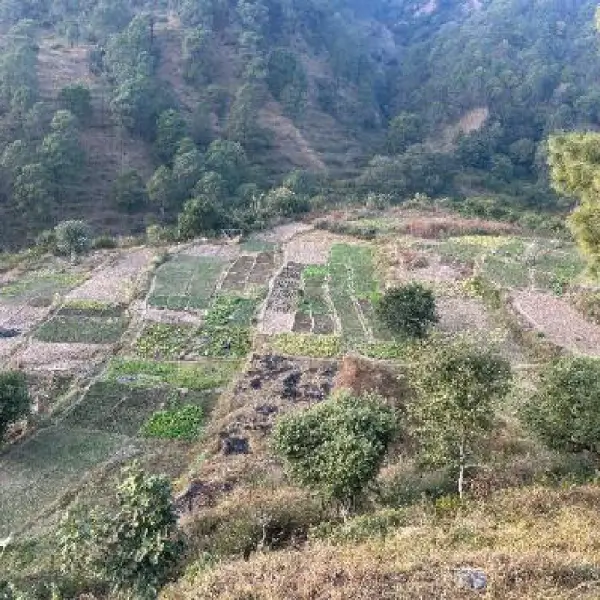
Terraced fields at Diusa, Pauri Garhwal, brought under cultivation through a gravity-fed irrigation scheme built with the village’s women’s groups.
Catchments Are the Weakest Link
The study’s most consistent finding concerned what happens upstream of the pump or pipe. Water sources in unmanaged Reserved Forest catchments recorded an average 38.3% decline in discharge since schemes were commissioned, against a comparatively modest 14.2% decline in protected Van Panchayat forest catchments. The single village that had actively treated its recharge zone, Saabli, recorded a 38% increase in discharge over the same period — the clearest evidence in the study that catchment treatment, not just infrastructure, determines whether a source survives.
The report also found that investment to date has concentrated heavily on the supply side — sources and storage tanks — while the last-mile distribution network has received comparatively little attention. An estimated 20–40% of water is lost to transmission and application inefficiency between tank and field, identifying on-farm water-use efficiency as the largest untapped gain available to future schemes.
Community Ownership, Institutions and Climate Risk
The study also examined the institutions that keep schemes running once external project support tapers off. Across Himmotthan-supported interventions, the implementing programme financed roughly 90% of scheme cost, leaving communities contributing about 10% — a ratio the report suggests leaves limited grounds for the accountability that sustains a scheme long-term, even as farmers interviewed said they were now more willing to raise their own contribution having seen irrigation’s effect on income. Where landholding is fragmented, Water User Groups have generally stepped in to manage schemes collectively, though monthly tariff collection was a recurring source of friction; the study recommends shifting to crop-season-based tariff collection instead.
Climate risk emerged as a further threat to durability: solar-powered lift schemes at two study villages were damaged by flash floods within the study period, underscoring that sustainability planning must weigh risk to the water source itself, not only to the irrigation asset built around it.
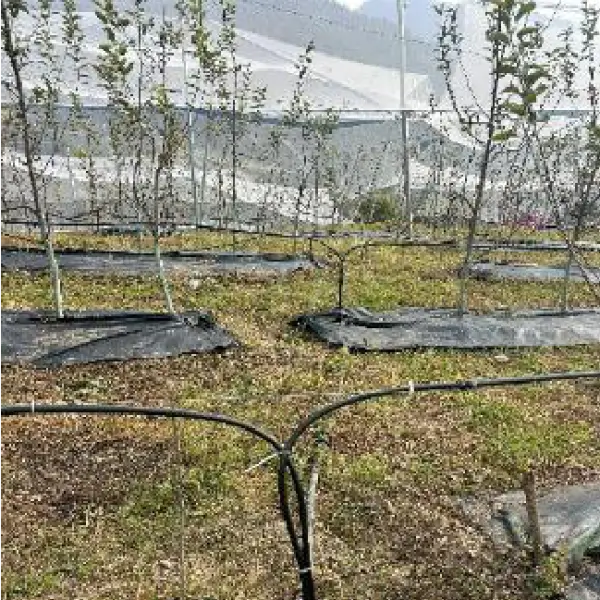
Drip irrigation lines laid along the planting rows of a high-density apple orchard at Pujargaon, Tehri Garhwal — one of the study’s best-performing interventions.
Recommendations and a Case for Phase II
The study’s recommendations span source protection, storage design, distribution efficiency, cropping support and institutional financing — including coordination with Uttarakhand’s newly constituted Spring and River Rejuvenation Authority (SARRA) on catchment treatment. Because fieldwork was conducted during the monsoon, when farmers in the region generally do not irrigate, most findings on water use and income draw on farmer recall rather than concurrent measurement. The study team has therefore proposed a Phase II of primary data collection running from March to November 2026, to validate these findings against a full agricultural cycle and generate field-tested evidence to inform irrigation policy and design at scale.
The full study — including detailed methodology, village-by-village case studies and complete findings — is available for download below.
